

Posted in Article
05.14.2026
A hybrid work strategy should not start with a company-wide mandate. It should start with the work itself.
For many CEOs and COOs, the remote-versus-hybrid-versus-in-person debate has become unnecessarily ideological. Some leaders want everyone back in the office. Others want maximum flexibility to protect retention and hiring reach. Both positions can miss the operational reality: different functions require different work models.
The strongest evidence points toward a more practical answer. Hybrid work has become the durable middle ground for many office-capable roles, but in-person work remains critical for apprenticeship, high-trust collaboration, regulated workflows, and physical operations. Fully remote work can be a strategic advantage when output is measurable, and talent access matters more than location.
According to the U.S. Bureau of Labor Statistics, 35.5 million people teleworked in the first quarter of 2024, representing 22.9% of the workforce. The same analysis found that teleworking for some hours increased, while teleworking for all hours declined, signaling that the labor market has been moving toward a hybrid rather than a simple remote-or-office split.
For executives, the goal is not to pick a standard work model and force every function into it. The better move is to segment work by function, role family, risk, and measurable outcomes. Use the links throughout this article to explore how ARC Group supports organizations with workforce planning, recruiting strategy, and critical talent needs.
Why a One-Size-Fits-All Work Policy Fails
The hybrid workforce is not one workforce
A hybrid workforce may include corporate finance teams, IT developers, sales managers, legal support, healthcare administrators, supply chain planners, and in-office workers who support physical operations.
Those roles do not have the same requirements.
A rigid policy creates problems when it treats:
- Site-bound work the same as knowledge work
- Early-career development the same as senior independent execution
- Regulated functions the same as low-risk administrative work
- Client-facing roles the same as back-office analytics
This is why corporate leaders need a function-based decision matrix rather than a blanket policy.
The evidence favors structured variation
A randomized controlled trial published in Nature found that a two-day home and three-day office schedule reduced quit rates by one-third without reducing performance reviews, promotion rates, or code output. Stanford’s summary of the same research described hybrid employees as just as productive, just as likely to be promoted, and far less likely to quit than fully office-based peers.
That does not mean every role should be hybrid. It means a well-designed hybrid work strategy can preserve performance while improving retention for many office-capable roles.
The CEO and COO Decision Matrix
How to weigh the major criteria
Executives should evaluate each function using six weighted criteria:
| Productivity measurability | 25% | Output depends on live coordination or physical workflow | Output mixes deep work and team execution | Output is individually measurable and mostly asynchronous |
|---|---|---|---|---|
| Collaboration and mentorship needs | 20% | Apprenticeship, coaching, brainstorming, and tacit learning are central | Collaboration can be concentrated into anchor days | Work is mostly independent and process-driven |
| Regulatory and supervision constraints | 20% | Physical controls or direct supervision are required | Controls are partly digital but benefit from periodic in-person review | Controls are digital, auditable, and location-independent |
| Talent access | 15% | Local labor market is sufficient | Broader geography helps but local team connection matters | Scarce talent requires remote location flexibility |
| Culture and change-readiness | 10% | Culture depends on frequent in-person collaboration | Culture can be built through rituals and manager discipline | Teams already operate well asynchronously |
| Real-estate and operating costs | 10% | Physical office spaces are mission-critical | Footprint can be redesigned around purpose | Maximum cost flexibility is needed |
This matrix forces leaders to ask a better question: what work model creates the best business outcome for this function?
How Each Model Fits Different Work
When in-person work is the stronger default
In-person work is usually best when the role depends on:
- Physical operations
- Direct client service
- Regulated supervision
- Apprenticeship and hands-on training
- Immediate problem-solving
- Equipment, facilities, or secure environments
This often applies to frontline healthcare, manufacturing, logistics, certain legal functions, and parts of financial services where controls and supervision matter.
When a hybrid is the strongest starting point
Hybrid is often the best default for office-capable work that requires both focus time and collaboration.
This includes roles where:
- Managers need recurring in-person collaboration
- The team needs to change week to week
- Mentoring matters but does not require daily office attendance
- Culture depends on shared rituals
- Individual output can still be measured
Gallup’s hybrid work research shows that six in 10 remote-capable employees prefer a hybrid arrangement, while about one-third prefer fully remote and fewer than 10% prefer on-site work.
When remote work can create an advantage
Fully remote work is strongest when:
- Output is measurable
- Security and supervision are digital
- Collaboration is asynchronous
- The local talent pool is limited
- Specialized skills are difficult to find near the office
Remote work can be especially valuable for mature roles in technology, analytics, digital marketing, and specialized support functions. It is less effective when teams depend heavily on apprenticeship, rapid coordination, or informal learning.
Why Collaboration and Culture Need More Precision
In-person collaboration should have a purpose
Many failed return-to-office policies share the same flaw: employees are asked to commute without a clear reason.
If office time is filled with individual laptop work, the policy becomes a commute burden rather than a productivity strategy.
Office time should be reserved for:
- Mentoring
- Decision-making
- Complex problem-solving
- Client strategy
- Innovation sessions
- Onboarding
- Manager coaching
A conducive hybrid workplace culture depends on purposeful office use, not random attendance.
Fully remote can work, but it needs stronger management
Gallup has also found that fully remote workers report higher engagement, but they are less likely to be thriving overall than hybrid workers or on-site remote-capable workers.
That matters because hybrid work success depends less on the policy label and more on manager quality.
Managers need to know how to:
- Set expectations clearly
- Coordinate hybrid work schedules
- Protect stronger work-life boundaries
- Avoid meeting overload
- Document decisions
- Maintain accountability across virtual spaces
Without this structure, remote and hybrid employees can fall into bad habits that reduce performance over time.
Sector-Specific Guidance for Work Model Decisions
Technology and IT
Technology teams often benefit from a hybrid model, with remote flexibility for scarce senior roles.
Engineering, cybersecurity, cloud, and data roles can often support remote execution when outcomes are measurable. However, architecture resets, onboarding, product strategy, and mentorship often benefit from planned in-person collaboration.
Relevant ARC support areas include Technology & IT Recruitment, IT Professional Services, and Recruitment Intelligence™.
Healthcare
Healthcare requires a role-based split model.
Direct patient-care roles are usually site-bound, while revenue cycle, scheduling, analytics, IT, payer-facing functions, and administrative support may be hybrid or remote if privacy and security controls are strong.
Relevant ARC support areas include Healthcare, Administration and HR, and Risk Solutions.
Finance
Finance is often hybrid, with stricter in-office expectations for supervisory, early-career, and client-facing populations.
Business and financial operations roles can frequently support flexibility, but supervision, culture, compliance, and sensitive work still matter. A finance hybrid workplace plan should separate analysis-heavy work from control-heavy work.
Relevant ARC support areas include Accounting & Finance, Executive Leadership, and Risk Solutions.
Supply Chain and Logistics
Supply chain and logistics often require in-person work for physical operations and hybrid models for planning functions.
Warehouse leadership, transportation coordination, and production-adjacent roles typically need site presence. Demand planning, procurement analytics, sourcing, and network design can often work in a flexible workplace model.
Relevant ARC support areas include Supply Chain & Logistics, placement services, and consulting services.
Sales and Marketing
Sales and marketing require segmentation by activity.
Field sales, major account work, and client-facing strategy may need more in-person work. Digital marketing, analytics, campaign operations, and content production may operate effectively in hybrid or remote models.
Relevant ARC support areas include Sales & Marketing and service overview.
Implementation Steps for Executives
Step 1: Decide by role family
Do not begin with a single headquarters policy.
Segment work into:
- Site-bound roles
- Collaboration-heavy roles
- Output-measurable roles
- Regulated roles
- Scarce-skill roles
- Early-career development roles
This helps corporate leaders avoid designing around personal preference.
Step 2: Create team anchor days
Team anchor days work better than random attendance.
They should be used for:
- Collaboration
- Mentoring
- Manager check-ins
- Client planning
- Cross-functional decisions
The purpose is to make in-office work valuable, not symbolic.
Step 3: Redesign the office purpose
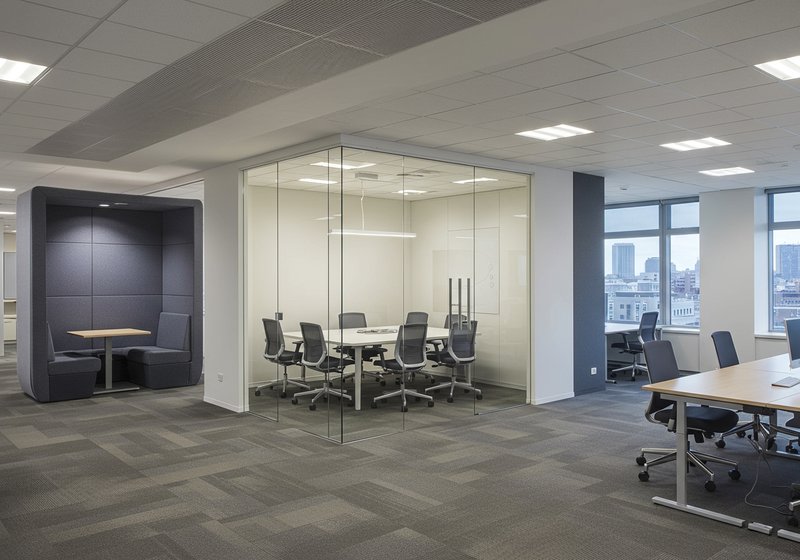
Physical office spaces should support the work that is best done in person.
That may mean fewer rows of desks and more space for:
- Collaboration rooms
- Training areas
- Client meetings
- Project war rooms
- Onboarding sessions
If the office does not support the work model, the model will fail.
Step 4: Set manager expectations
Managers are the operating system of a hybrid workforce.
They should be expected to:
- Define team norms
- Coordinate hybrid work schedules
- Measure outcomes
- Document decisions
- Maintain team connection
- Identify performance issues early
A successful hybrid workplace depends on manager discipline more than policy language.
Step 5: Measure outcomes quarterly
Executives should track whether the model is working.
Key metrics include:
- Time to fill
- Offer acceptance rate
- Regretted attrition
- Retention by role family
- New-hire ramp time
- Manager-rated collaboration quality
- Output against team goals
- Real-estate utilization
CBRE’s 2025 office research found that increasing office utilization remains a top goal for many corporate real estate teams, with utilization increasingly tracked as a key metric.
The important point is measurement. A hybrid work strategy should be evaluated by business outcomes, not office attendance alone.
What ARC Group Helps Companies Evaluate
American Recruiting & Consulting Group helps employers evaluate work model decisions through the lens of hiring, retention, workforce planning, and role design.
As an award-winning recruiting firm with more than 40 years of experience, ARC Group supports companies across executive leadership, consulting services, placement services, Recruitment Intelligence™, industry overview, Technology & IT Recruitment, Healthcare, Accounting & Finance, Supply Chain & Logistics, Risk Solutions, Administration and HR, and Sales & Marketing.
That matters because the remote, hybrid, or in-person decision directly affects hiring speed, candidate access, retention, manager effectiveness, and long-term workforce planning.
A practical work model should answer three questions:
- What does the role require?
- What does the market expect?
- What structure best protects performance and retention?
The strongest companies will not win by declaring one model for everyone. They will win by designing work around function, risk, talent access, and measurable outcomes.