

Posted in Talent Acquisition
07.28.2026
RECRUITING & STAFFING TRENDS · 2026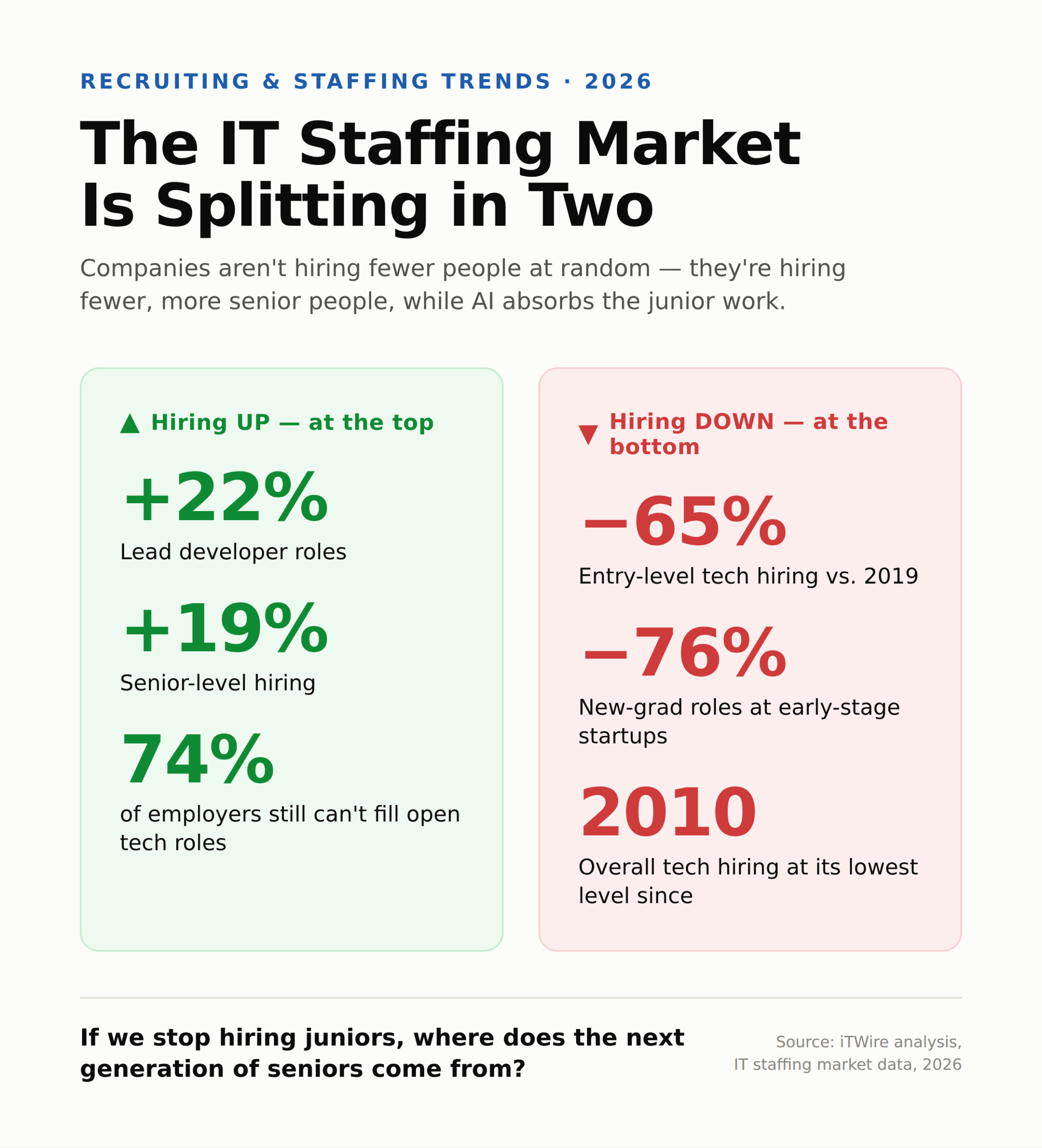
The IT Staffing Market Is Splitting in Two
And the companies that ignore it will pay for it in 2030
There’s a contradiction sitting in the middle of the tech hiring market right now, and most leaders are only looking at one half of it.
On one side, roughly 74% of employers say they can’t fill their open technology roles. On the other, entry-level tech hiring has fallen about 65% compared to 2019, and new-grad roles at early-stage startups are down somewhere near 76%. Overall tech hiring recently hit its lowest level since 2010.
Read those numbers together and they seem impossible. If talent is so scarce that three out of four employers can’t staff their open roles, why has the bottom of the hiring ladder collapsed? Scarcity and a hiring freeze don’t usually happen at the same time.
They’re happening now because the market isn’t shrinking. It’s splitting. And understanding why is the difference between a company that has a strong technical bench in five years and one that’s paying a premium for senior talent it could have grown itself.
What’s actually driving the split
The simplest way to describe what’s happening: companies are hiring fewer people, but far more senior ones. Lead developer hiring is up around 22%. Senior-level hiring is up roughly 19%. The demand hasn’t disappeared — it’s moved up the experience curve.
Three forces are pushing it there.
- AI has absorbed the traditional junior workload. For decades, a junior engineer’s first two years were an apprenticeship in disguise. They wrote boilerplate, fixed small bugs, wrote tests, and slowly absorbed how real systems fit together. That work was never the point — the learning was the point. But that exact tier of work is what AI coding tools now do fastest and cheapest. From a short-term productivity standpoint, the junior role looks redundant: a senior engineer with AI assistance can do what used to take a small team of juniors.
- The economics reward seniority. A fully-loaded senior US developer can cost north of $200,000. That’s expensive — but a senior person who can architect, review AI output, and direct the work is now doing the output of several people. Meanwhile the “cheap” tier that used to justify hiring juniors — routine implementation — has been commoditized. Companies are concluding, role by role, that they’d rather pay for one person who can steer than three who need steering.
- Nobody wants to pay to train talent that might leave. Turning a junior into a productive senior takes two to four years. In a market where people change jobs frequently, the company that invests in that training often isn’t the one that reaps the benefit. So everyone waits for someone else to develop the talent — and then competes to hire it. That’s the “74% can’t fill roles” number in a nutshell: everyone is fishing in the same shrinking pond of already-senior people, because almost no one is stocking the pond.
The problem nobody has priced in
Seniors are not born. Every senior engineer, architect, and technical lead was once a junior who spent years learning the trade on someone’s payroll.
If the industry stops hiring and developing juniors today, the supply of mid-level talent dries up in three to four years, and the supply of senior talent — the exact people 74% of employers already can’t find — dries up in five to seven. The current shortage isn’t the crisis. It’s the early warning of a much worse one.
Companies are, in effect, eating their seed corn. The savings from not hiring juniors show up on this year’s budget. The cost shows up several years out, when the senior pipeline runs dry and the only option is to pay whatever the market demands for the few seniors who exist. That bill will land on the companies that cut deepest and earliest — and it will be far larger than what they saved.
What clients should focus on now
The good news: this is solvable, and the companies that solve it will have a durable cost and capability advantage over the ones that don’t. Here’s where to focus.
Reframe the junior role as “AI-augmented,” not “entry-level.” The old junior job — grinding through boilerplate — is genuinely gone, and trying to recreate it is a mistake. The new version is a person who works alongside AI tools from day one: generating, reviewing, testing, and learning to judge the quality of AI output. That’s a real, valuable role, and it develops exactly the judgment seniors need. Redefine the job around the tools that exist now, and the “juniors add no value” objection largely disappears.
Build deliberate apprenticeship and upskilling pipelines. If the market won’t develop talent, the companies that do it internally gain a structural edge. That means structured mentorship, protected learning time, rotations across teams, and a defined path from AI-augmented junior to independent contributor. It’s an investment, but it’s cheaper than the senior premium you’ll pay in five years — and it improves retention, because people stay where they’re growing.
Treat internal mobility as a talent source, not an afterthought. Some of your best future engineers are already in the building — in QA, support, operations, or adjacent roles — and want to grow technically. Formal reskilling paths turn people who already understand your business into technical contributors, faster and more loyally than external hires.
Use flexible and contract staffing to bridge the gap, not to avoid the problem. Contract and contract-to-hire talent lets you meet immediate senior needs without a permanent commitment, and it gives you a low-risk way to trial emerging talent before converting them. The mistake is using contractors purely as a stopgap while the underlying pipeline problem quietly worsens. Use flexible staffing to buy time — then use that time to build the bench.
Track the leading indicators, not just the lagging ones. Most companies watch time-to-fill and cost-per-hire. Those are lagging. The leading indicators of a future talent gap are your junior-to-senior ratio, your internal promotion rate into senior technical roles, and how much of your senior work depends on people who could retire or leave within a few years. If that last number is high and your junior pipeline is thin, you already have the problem — it just hasn’t shown up on a budget yet.
The bottom line
The IT staffing market splitting in two isn’t a temporary distortion that will correct itself. It’s the predictable result of AI reshaping what junior work is worth, combined with an industry-wide reluctance to invest in developing the seniors of tomorrow.
The companies that treat this as a reason to stop hiring juniors are optimizing for this year’s budget at the expense of the next decade’s capability. The companies that treat it as a reason to redesign how they develop talent — AI-augmented roles, real apprenticeship pipelines, internal mobility, and flexible staffing used strategically — will be the ones with a deep, affordable bench when everyone else is bidding for the same handful of seniors.
The talent gap of 2030 is being created by hiring decisions in 2026. The best time to start closing it is now.
Sources
iTWire — “The IT Staffing Market Is Splitting in Two, and the Data Proves It”