

Posted in Talent Acquisition
08.31.2026
Your Best Candidate Is Interviewing Somewhere Else
The strongest candidate in your hiring process is probably not waiting for you to make a decision.
They are interviewing with other companies, responding to recruiters, comparing opportunities, and deciding which organization appears most serious about hiring them. Yet many employers still operate as if qualified candidates will remain available while internal approvals, additional interviews, and scheduling delays stretch the hiring process across weeks.
That assumption creates an expensive recruiting problem.
A company can identify the right person, conduct strong interviews, and build genuine candidate interest—then lose that person simply because someone else moved faster.
Slow Hiring Has Become a Competitive Disadvantage
Hiring carefully and hiring slowly are not the same thing.
A thorough recruiting process should improve decision-making. It should establish what the role actually requires, evaluate candidates consistently, verify qualifications, and create alignment between the employer and candidate.
But additional delays do not necessarily create additional certainty.
An interview that takes a week to schedule, feedback that sits unanswered for several days, or an offer requiring multiple unnecessary approvals can turn a disciplined hiring process into organizational friction.
For high-demand professionals, that friction matters because employers are rarely evaluating candidates in isolation. Candidates are evaluating employers at the same time.
The hiring process itself becomes part of the employment offer.
When communication is organized, expectations are clear, and decisions move efficiently, candidates see an organization capable of making decisions. When the process repeatedly stalls, they may reasonably wonder whether the same delays exist inside the company after they are hired.
The Candidates You Want Usually Have Options
The challenge becomes even greater when recruiting experienced professionals, specialized technical talent, high-performing salespeople, or executives.
The best candidate may already have a good job.
That means the employer is not simply competing against another open position. It may be competing against the candidate’s current salary, existing relationships, accumulated benefits, flexibility, career trajectory, and the comfort of staying where they are.
Changing jobs has to offer enough value to justify that disruption.
Once a strong candidate decides to explore the market, multiple employers may recognize the same qualities that attracted your hiring team.
Every unnecessary delay creates another opportunity for a competitor to move first.
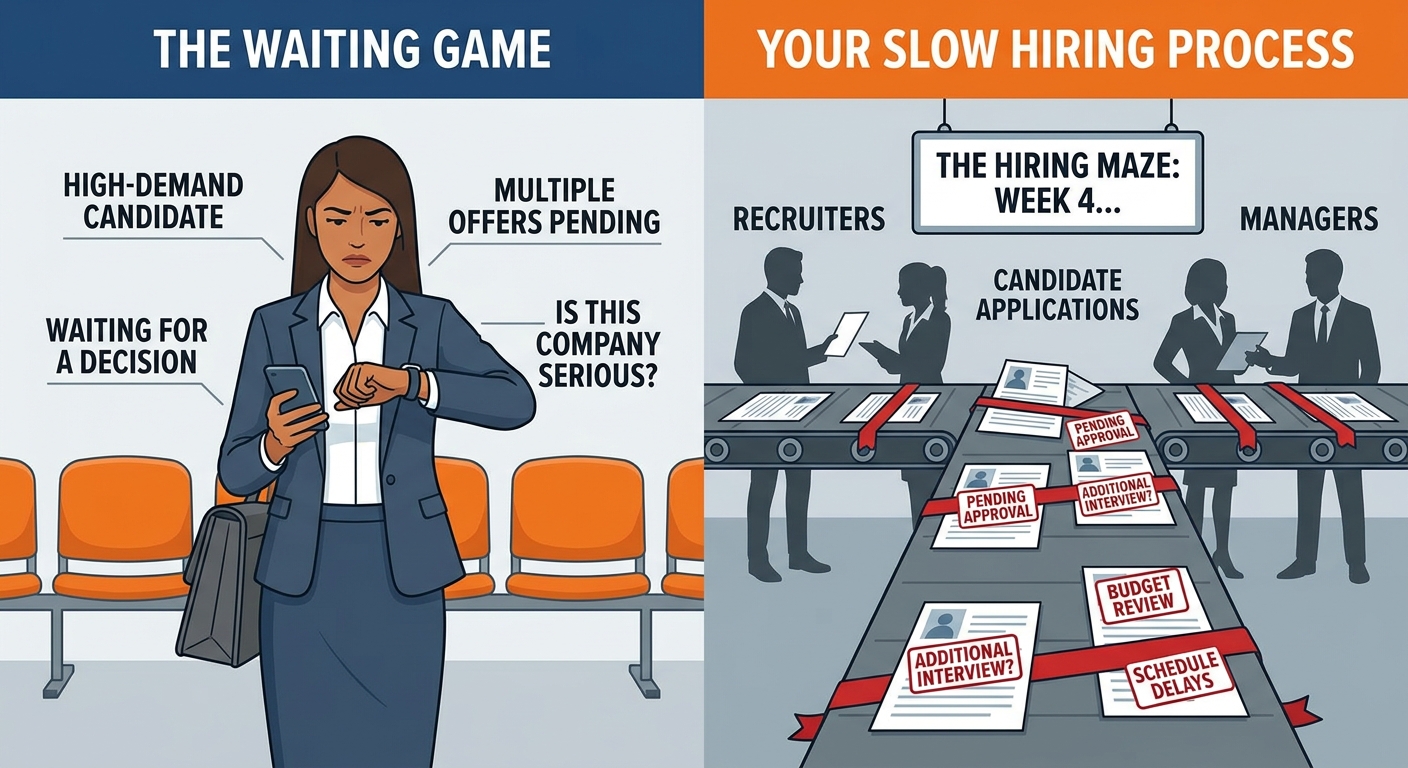
More Interviews Don’t Always Mean Better Decisions
One common response to hiring uncertainty is adding another interview.
Then another stakeholder.
Then another conversation to make sure everyone agrees.
For some senior or highly specialized positions, multiple evaluation stages are necessary. But companies should distinguish between interviews that provide new information and interviews that simply repeat questions candidates have already answered.
A useful question for hiring leaders is:
What will we know after this interview that we don’t know now?
If there is no clear answer, the additional stage may not be improving the hiring decision.
Structured interviews can help organizations evaluate candidates more consistently while reducing unnecessary repetition. Before recruiting begins, employers should determine which competencies matter, who is responsible for evaluating them, and what evidence will support a hiring decision.
That preparation can make the process both more thorough and more efficient.
Candidate Silence Creates Its Own Message
Not every delay can be avoided.
Schedules conflict. Priorities change. Decision-makers travel. Budgets occasionally require additional approval.
Candidates understand that.
What creates problems is uncertainty.
A candidate who knows, “We’re completing final interviews Thursday and expect to have an update Friday,” has a reason to remain engaged.
A candidate who hears nothing for eight days has to interpret the silence.
And silence rarely increases enthusiasm.
Consistent communication is one of the simplest ways to protect candidate engagement. Even when there is no final decision, providing an honest update demonstrates that the organization respects the candidate’s time and remains interested in the conversation.
Build the Hiring Process Before You Need the Hire
Many recruiting delays begin long before the first interview.
The organization opens a position without fully agreeing on compensation, responsibilities, required qualifications, interview participants, or who ultimately owns the hiring decision.
Those unresolved questions eventually surface during the recruiting process.
The result can be changing requirements, conflicting interviewer feedback, additional interviews, delayed offers, or—in the worst cases—restarting the search.
Employers can reduce that risk by calibrating the position before going to market.
Before recruiting begins, hiring teams should be able to answer several basic questions:
- What does this person need to accomplish in the first 6 to 12 months?
- Which qualifications are genuinely required?
- Which qualifications are preferences rather than necessities?
- What compensation range has actually been approved?
- Who needs to interview the candidate?
- What specifically is each interviewer evaluating?
- Who makes the final decision?
- How quickly can an offer be approved?
When those questions have clear answers, recruiters can search more precisely and hiring managers can make decisions with greater confidence.
Speed Should Come From Preparation, Not Pressure
The solution to slow hiring is not rushing candidates through the process.
It is removing unnecessary friction from the process.
There is an important difference.
Employers should still conduct appropriate interviews, verify experience, assess alignment, complete necessary background checks, and understand why a candidate is interested in making a move.
The goal is not to make a faster bad decision.
The goal is to make a well-informed decision without wasting time between the steps that actually matter.
That requires preparation before the search, communication during the search, and clear ownership when it is time to make a decision.
Recruiting Is a Two-Way Evaluation
Companies spend significant time determining whether candidates are right for their organization.
Strong candidates are doing exactly the same thing.
They notice how prepared interviewers are. They notice whether different leaders describe the position consistently. They notice how quickly questions are answered and whether promised follow-ups actually happen.
Those experiences provide an early preview of what working for the organization might feel like.
In a competitive talent market, candidate experience is therefore more than a recruiting courtesy. It can influence whether the person you ultimately select is still available when you’re ready to make the offer.
How ARC Group Helps Companies Compete for Top Talent
For more than 40 years, American Recruiting & Consulting Group has helped organizations identify, evaluate, recruit, and secure professionals across a wide range of industries and functions.
Our recruiting process is designed to combine thorough candidate evaluation with the market intelligence and communication required to keep strong candidates engaged throughout the search.
Through permanent placement, contract staffing, contract-to-permanent solutions, executive recruiting, consulting, and Recruitment Intelligence™, ARC Group helps clients build hiring processes around the realities of today’s talent market—not the assumption that exceptional candidates will wait indefinitely.
Because finding the right candidate is only part of successful recruiting.
You also have to be ready to hire them when you find them.
Looking for the right talent for your organization? Contact ARC Group to learn how a more focused recruiting strategy can help you identify and secure the professionals your business needs.