

Posted in Uncategorized
08.17.2026
What Employers Need to Know Now
The U.S. labor market is sending employers a message that may seem contradictory.
Hiring has slowed. Job seekers are finding it harder to make their next move. Yet many employers are still struggling to find the right people for critical positions.
Welcome to the hiring market of 2026.
The latest employment data shows a market that is neither booming nor collapsing. Instead, it is becoming more selective. Employers are being more deliberate about adding headcount, employees are less willing to leave existing positions without a compelling opportunity, and the qualifications companies expect from new hires are evolving quickly.
For businesses planning to hire during the second half of 2026, understanding that shift is becoming increasingly important.
Hiring Has Slowed, But the Talent Problem Hasn’t Disappeared
According to the U.S. Bureau of Labor Statistics, nonfarm payroll employment changed little in July, declining by 23,000 jobs, while the unemployment rate remained relatively low at 4.1%.
At the same time, approximately 7.4 million job openings remained across the U.S. economy in June.
That combination tells an important story.
Companies may be hiring more cautiously, but employers have not stopped looking for talent.
The challenge is increasingly about finding candidates with the right combination of experience, skills, adaptability, and industry knowledge rather than simply filling seats.
For employers, that means a larger applicant pool does not necessarily make recruiting easier.
More applicants do not automatically mean more qualified candidates.
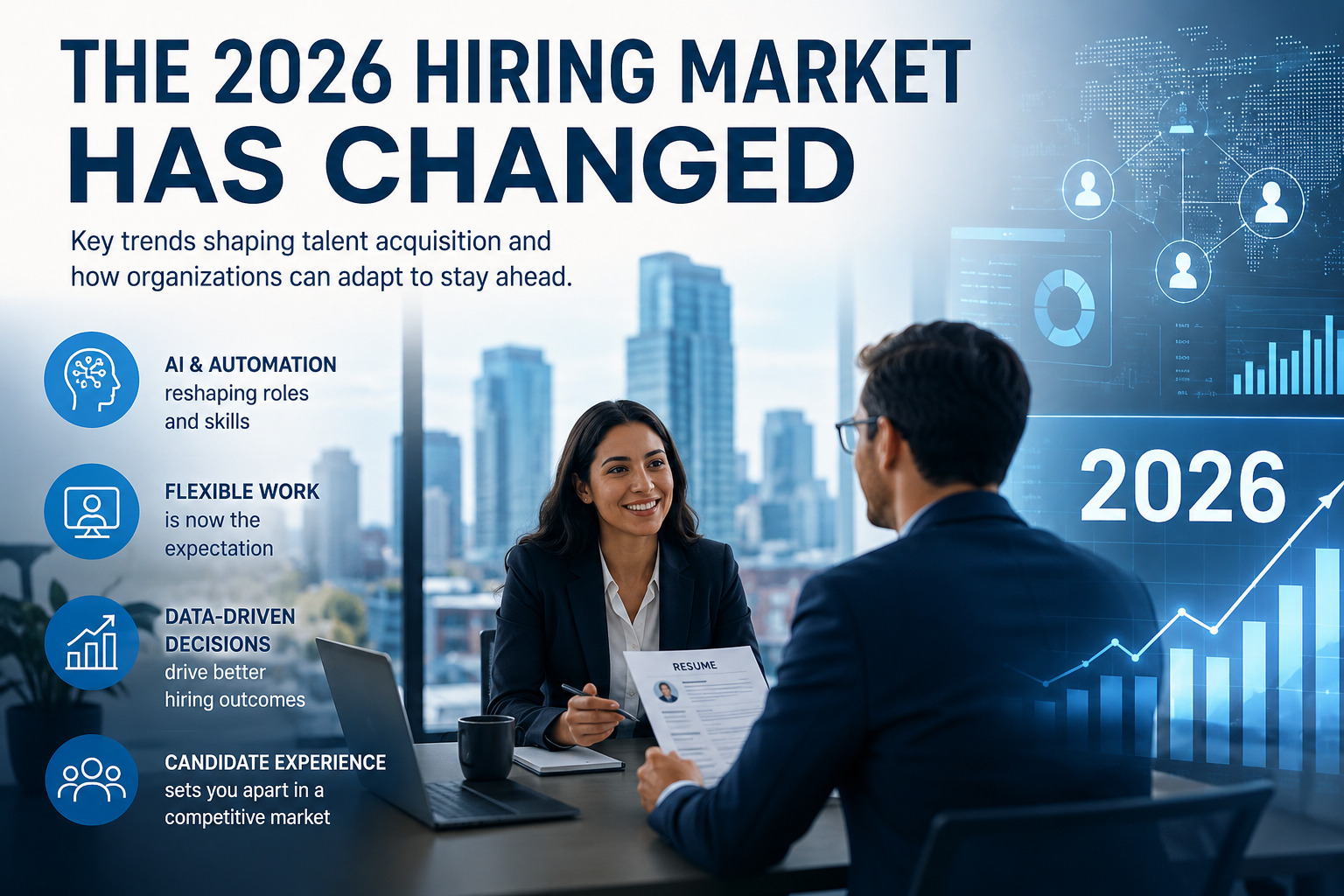
Employers Have Become More Selective
During periods of aggressive hiring, companies may be willing to hire candidates who meet most of their requirements and develop the remaining skills after they join.
Today’s environment is different.
With organizations watching expenses and headcount more carefully, each new hire may face greater scrutiny. Hiring managers increasingly want candidates who can contribute quickly and demonstrate measurable value.
That can create an interesting recruiting problem.
Companies may receive hundreds of applications while still struggling to identify a handful of people who genuinely match the position.
The result is a market where recruiting quality matters more than recruiting volume.
Successful hiring teams need to know exactly what they are looking for before the search begins.
Employees Aren’t Moving as Freely Either
The current market has changed employee behavior as well.
The national quits rate remained at 2.0% in June, according to the Bureau of Labor Statistics. Lower voluntary turnover can indicate that workers are becoming more cautious about leaving their existing positions.
That matters for recruiters.
Some of the best potential candidates may not be actively applying for jobs at all.
They may be employed, performing well, and willing to consider another opportunity—but only if someone brings the right opportunity to them.
Posting a position online and waiting for applications will reach one portion of the talent market.
It won’t necessarily reach all of it.
This is where proactive recruiting becomes especially valuable. Identifying and engaging passive candidates can give employers access to professionals they would never encounter through applications alone.
AI Is Changing What Companies Expect From Candidates
Artificial intelligence is also beginning to reshape hiring in a more practical way.
The conversation is no longer simply about whether AI will replace jobs.
Increasingly, the question is:
Can this candidate use new technology to perform the job better?
Companies are incorporating AI into research, analytics, software development, customer service, marketing, finance, recruiting, operations, and many other functions.
That does not mean every employee needs to become an AI specialist.
It does mean adaptability is becoming a more valuable professional skill.
Employers should think carefully about what technological capabilities actually matter for each position rather than simply adding “AI experience” to every job description.
The strongest candidate may not be the person who knows the most AI tools today. It may be the person who has demonstrated an ability to learn new systems, evaluate information critically, and adapt as technology changes.
The Resume Is Becoming Only Part of the Story
Another shift in recruiting is the growing importance of demonstrated skills.
Degrees, certifications, previous employers, and job titles still provide useful information, but they do not always tell employers what someone can actually accomplish.
Hiring teams are increasingly interested in evidence.
What did the candidate improve?
What problems did they solve?
What measurable results did they produce?
How did their responsibilities change?
How quickly have they adapted to new technology or business conditions?
That creates an opportunity for employers to rethink how candidates are evaluated.
Instead of searching for someone whose resume perfectly mirrors the job description, companies can focus on identifying the skills and behaviors that predict success in the position.
A Slower Market Doesn’t Mean Employers Can Move Slowly
There is also a dangerous assumption companies can make in today’s environment.
Because candidates have fewer opportunities than they did during the post-pandemic hiring boom, employers may assume they have unlimited time to make hiring decisions.
They don’t.
Exceptional candidates are still exceptional candidates.
A highly qualified professional with specialized experience can attract multiple employers regardless of broader labor-market conditions.
Companies that identify the right candidate and then spend weeks scheduling interviews, collecting feedback, or approving an offer can still lose that candidate to a competitor.
Hiring carefully makes sense.
Creating unnecessary delays does not.
The Market Is Increasing the Value of Specialized Recruiting
This environment creates a paradox for employers.
There may be more people looking for work, but finding the right person can still be difficult.
Sorting through hundreds of applications is not the same as recruiting.
Recruiting means understanding the position, identifying where qualified professionals can be found, determining which candidates actually match the opportunity, and engaging those candidates effectively.
That distinction becomes more important as employers become increasingly selective.
The question isn’t:
“How many candidates can we find?”
It is:
“How quickly can we identify the candidates who actually matter?”
What Employers Should Do in the Second Half of 2026
Companies planning to hire should use the changing market as an opportunity to become more disciplined about recruiting.
Start by clearly defining what success looks like in the position.
Separate essential qualifications from preferences.
Evaluate candidates based on demonstrated capabilities rather than keywords alone.
Know the compensation range before beginning the search.
Keep strong candidates informed throughout the process.
And when specialized talent is difficult to find, look beyond the candidates actively submitting applications.
Most importantly, companies should resist the temptation to interpret a slower labor market as an easy hiring market.
Those are not the same thing.
The Competitive Advantage Is Finding the Right Person
The hiring environment has changed significantly over the past several years, and it will continue changing as technology, demographics, and economic conditions reshape the workforce.
But one fundamental recruiting principle has not changed.
Companies perform better when they have the right people in the right positions.
For more than 40 years, American Recruiting & Consulting Group has helped organizations identify and recruit professionals across industries and functions through permanent placement, contract staffing, executive search, consulting, and Recruitment Intelligence™.
Today’s market may produce more applications.
Our focus remains on something much more important:
Finding the people who can make a difference to your organization.
If your organization is hiring in 2026, ARC Group can help you navigate today’s changing talent market and identify the professionals your business needs to move forward.