

Posted in Uncategorized
08.14.2026
Why the job-switcher pay premium widened in a market everyone calls “frozen”
For most of the past year, the story recruiters kept hearing was that candidate leverage had evaporated. Hiring had cooled, reqs were slower to open, and the advice to workers was to sit tight and be grateful. So the sensible expectation for July was that the reward for changing jobs — the pay bump switchers have enjoyed since the post-pandemic scramble — would finally compress toward the raise you get for staying put.
It didn’t. It did the opposite.
ADP’s July National Employment Report, released August 5, showed private employers added just 44,000 jobs — a barely-there number by any historical standard. But buried under that soft headline was the figure that should matter most to anyone who places people for a living: workers who stayed in their jobs saw pay rise 4.4% year over year, while workers who switched jobs saw 7.0% — the widest gap between the two since August 2025.
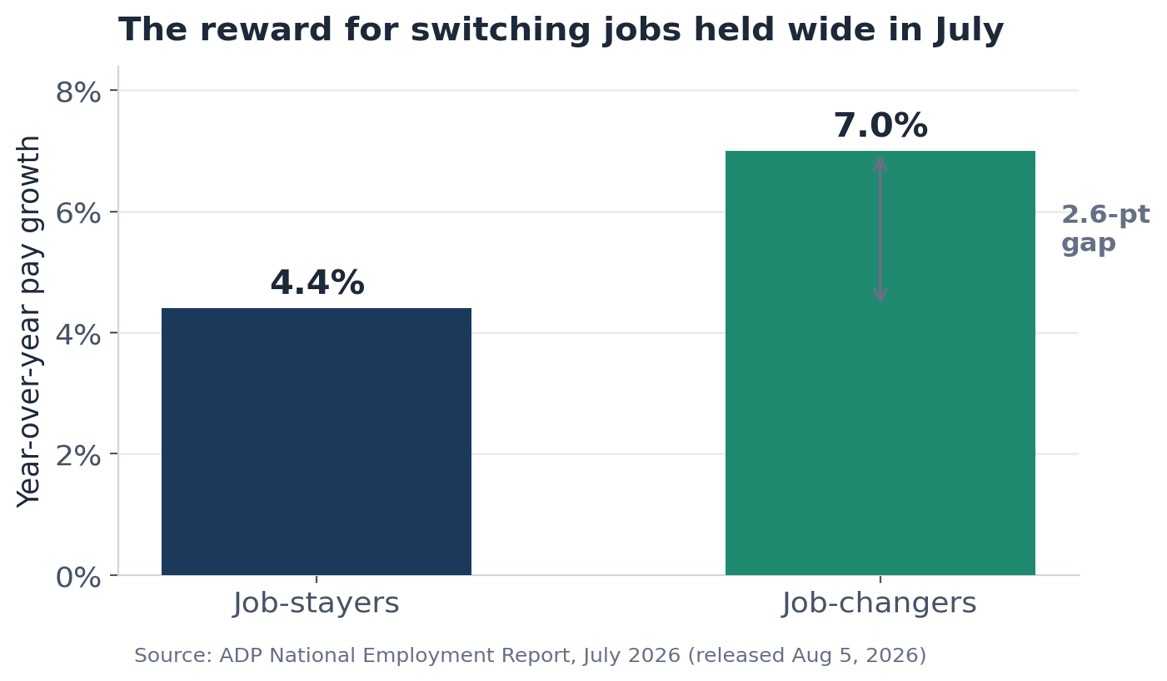 Figure 1 — Stayers vs. switchers, year-over-year pay growth, July 2026.
Read that again in plain terms. In a month when hiring nearly stalled, the people who moved still captured a raise roughly 2.6 percentage points larger than the people who didn’t. The market can feel frozen and the move can still be worth real money at the same time.
Why this is counterintuitive — and why it’s happening anyway
The intuitive model says a slack labor market kills the switcher premium. When employers hold the cards, they don’t need to overpay to poach talent, so the gap between stayers and changers should shrink. And in aggregate hiring, the market genuinely is slack: the same week ADP landed, the Bureau of Labor Statistics reported that nonfarm payrolls actually fell by 23,000 in July, with unemployment holding at 4.1%.
So why is the switch still paying off? Because “the labor market” is not one market. It’s dozens of them, and demand right now is narrow rather than broad. ADP’s own July breakdown shows where the hiring actually happened: education and health services added 36,000 jobs, professional and business services added 9,000, and information services added 5,000, while goods-producing industries shed 3,000. Employers aren’t competing for everyone. They’re competing hard for specific people in specific functions — and for those people, the premium is alive and, if anything, sharpening.

Figure 2 — Private-sector job change by industry, July 2026.
That’s the distinction that gets lost in the headline number. A near-zero net hiring figure can hide fierce competition for the right candidate underneath a frozen surface. Averages conceal scarcity.
What this means if you recruit for a living
This is, in one statistic, the entire value proposition of the recruiting desk.
When a passive candidate tells you they’re “happy where they are,” they are usually pricing their situation off the stayer raise — the 4.4% their current employer will hand them at review time. What they often don’t know is that the market is quietly paying 7% to people who move. The gap between those two numbers is not a vibe or a pitch you have to manufacture. It’s a documented, published spread. Your job is to make an implicit trade explicit: here is what loyalty is costing you, in basis points, right now.
The nuance to hold onto is that the premium is concentrated, not universal. It’s strongest in the functions where demand held up — healthcare, professional services, tech-adjacent roles. So the play isn’t to blast every candidate with “the market’s paying more.” It’s to know which of your desks sit in the scarcity lanes and lean into the data there, where it’s actually true.
What this means if you’re trying to keep your team
The same report is a retention warning wearing a payroll disguise.
A cooling market is easy to misread as a loyal one. It isn’t. Your best people can read the same ADP release you can, and a 2.6-point pay gap is a strong, rational reason to take a recruiter’s call — especially when the roles still being filled are the ones your top performers happen to hold. Slack aggregate hiring doesn’t protect you if your talent sits in one of the lanes where demand never softened.
The uncomfortable implication is that retention isn’t a problem you solve once with a market adjustment and forget. It’s a spread you have to keep closing. As long as the outside market pays a premium to switch, the gap between what you pay to keep someone and what they could get by leaving is the real measure of your flight risk — not their tenure, not their stated happiness, and not the soft national headline.
Three questions worth asking this quarter
- Where do my roles actually sit — in the scarcity lanes (healthcare, professional services, tech) where the 7% premium is live, or in the softer parts of the market where it isn’t? The answer changes both your recruiting pitch and your retention exposure.
- What is my own stay-versus-leave gap? If I put a real number on what my best people could earn by switching, how far is it from what I’m paying them to stay?
- Am I managing to the headline or the spread? The national number says “cool it, the market’s soft.” The spread says “your best people still have a live market.” Only one of those is actionable.
The takeaway from July is not that the labor market is hot — it plainly isn’t. It’s that “soft market” and “loyal workforce” are two different things, and 2026 keeps proving they can move in opposite directions. The people who move are still winning. The desks and the employers who understand why are the ones who’ll turn that spread into an advantage instead of a surprise.
Sources
ADP National Employment Report, July 2026 (released Aug 5, 2026) — https://mediacenter.adp.com/2026-08-05-ADP-National-Employment-Report-Private-Sector-Employment-Increased-by-44,000-Jobs-in-July-Annual-Pay-was-Up-4-4
Barchart summary of the ADP July 2026 report — https://www.barchart.com/story/news/3662033/adp-national-employment-report-private-sector-employment-increased-by-44-000-jobs-in-july-annual-pay-was-up-4-4
BLS Employment Situation, July 2026 (payrolls −23,000, unemployment 4.1%) — https://www.bls.gov/news.release/empsit.nr0.htm