

Posted in Executive recruiting
09.29.2026
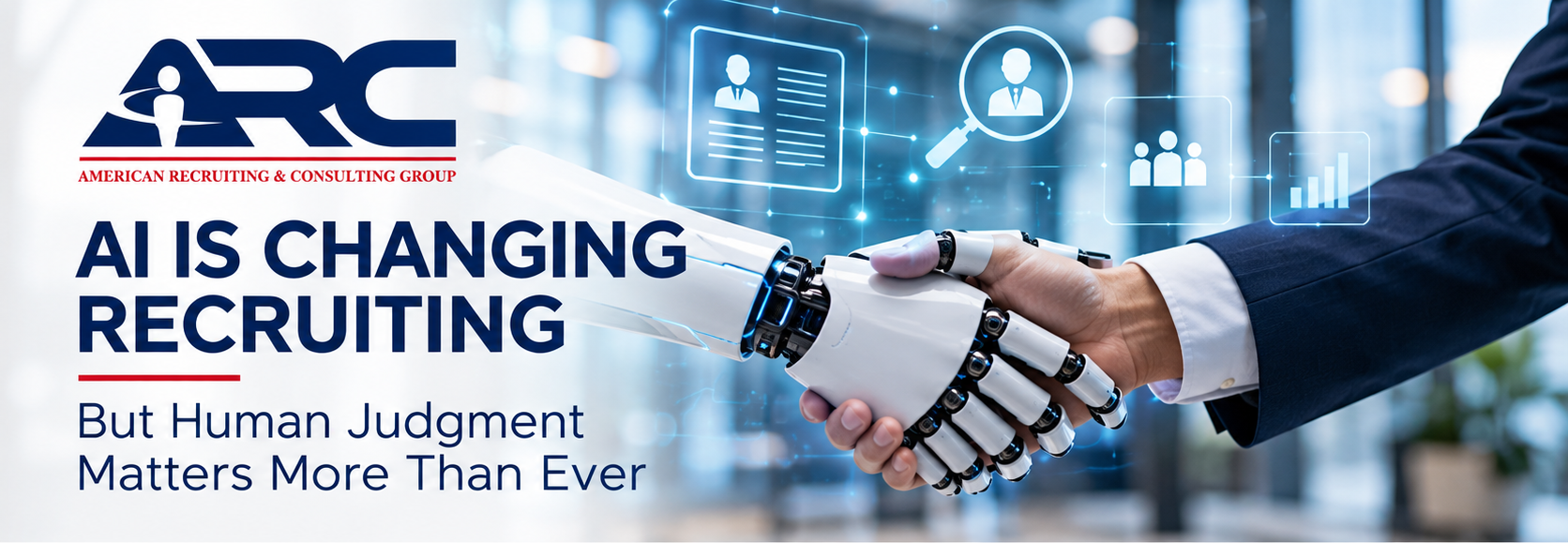
AI Is Changing Recruiting — But Human Judgment Matters More Than Ever
Artificial intelligence has moved from an emerging recruiting technology to an everyday part of the hiring process.
Employers now use AI to help source candidates, screen applications, schedule interviews, draft communications, and analyze talent markets. Candidates are using many of the same technologies to improve resumes, research employers, prepare for interviews, and identify opportunities.
The result is a hiring environment that can move faster than ever before. But faster does not automatically mean better.
As AI handles more of the repetitive work involved in recruiting, the value of experienced human judgment is becoming even more important.
AI Is Raising the Speed of Recruiting
One of AI’s greatest advantages in talent acquisition is scale.
Recruiters can use technology to analyze larger candidate pools, identify relevant skills, organize applicant information, and automate administrative tasks that previously consumed hours of their time.
That efficiency can translate into a better experience for employers and candidates.
According to Bullhorn’s 2026 GRID Talent Trends Report, 92% of surveyed candidates who had experienced an AI voice interview rated it as good as or better than an interview with a live recruiter. The research suggests candidates are receptive to AI when it makes recruiting faster, more responsive, and easier to navigate.
But automation is only one part of an effective hiring strategy.
More Applications Don’t Always Mean Better Candidates
AI has also made applying for jobs easier.
Candidates can quickly customize resumes, generate cover letters, identify keywords, and apply to significantly more positions. For employers, that can mean receiving a larger volume of applications without necessarily receiving a larger number of qualified candidates.
Hiring teams still have to answer the question that matters most:
Which candidate is actually right for this position and this organization?
That requires more than keyword matching.
A resume can identify experience and credentials. It cannot fully explain why someone is considering a career change, what motivates that person, how effectively they communicate, or whether their expectations align with the employer’s needs.
Those are areas where experienced recruiters continue to provide substantial value.
The Best Recruiting Model Combines Technology and Human Expertise
The future of recruiting does not have to be a choice between artificial intelligence and human recruiters.
The strongest model combines both.
AI can support recruiters by processing information, identifying potential matches, automating repetitive tasks, and helping teams work more efficiently. Recruiters can then focus their time on the parts of hiring that require context, communication, judgment, and relationship building.
That combination allows recruiting teams to move quickly without reducing candidates to data points.
For employers, it can mean:
- Faster identification of qualified candidates
- More efficient screening and sourcing
- Better communication throughout the hiring process
- Greater insight into candidate motivations and expectations
- More recruiter time dedicated to high-value conversations and decision-making
Technology should make recruiters more effective—not make recruiting less human.
Candidates Still Want Human Interaction
Even as candidates become more comfortable with AI, human interaction remains important.
ClearlyRated’s 2026 Staffing Candidate Insights Report found that 66% of surveyed candidates wished a human recruiter reviewed their application, while only 46% believed that was currently happening.
The same research found that 36% would lose trust and reconsider working with a staffing firm if they discovered that AI screening had been used without disclosure.
These findings highlight an important distinction: candidates may welcome technology that improves their experience, but transparency and personal engagement still matter.
Bullhorn’s research reached a similar conclusion. Candidates who communicated with recruiters at least weekly were highly likely to continue working with those recruiters.
The technology may be changing. The importance of trust is not.
AI Is Also Changing the Skills Employers Need
Artificial intelligence is not only changing how companies recruit. It is changing what companies recruit for.
Organizations increasingly need employees who can work effectively with AI-enabled tools, even in positions that are not traditionally considered technology roles.
Recent iCIMS workforce research found that candidates are developing AI skills rapidly, often through their own initiative rather than employer-provided training. At the same time, demand for AI-related capabilities is spreading across occupations and industries.
That creates another challenge for hiring managers: determining what AI proficiency actually means for a specific role.
Simply adding “AI experience” to a job description may not be enough. Employers need to identify the specific capabilities that improve performance in the position and evaluate candidates accordingly.
An experienced recruiting partner can help organizations distinguish between desirable buzzwords and the skills that actually matter.
Why Recruiting Expertise Matters in an AI-Driven Market
As recruiting technology becomes more powerful, employers have access to more information, more candidates, and more automation.
They also have more noise to navigate.
Finding a candidate is not the same as finding the right candidate.
Effective recruiting still requires understanding the position, the organization, the candidate, the market, and the circumstances surrounding a potential hire. Technology can strengthen that process, but the final connection between an employer and a candidate depends on factors that are difficult to capture through an algorithm alone.
That is why the role of recruiters is evolving rather than disappearing.
The administrative side of recruiting can become increasingly automated. The strategic side—talent intelligence, candidate engagement, market knowledge, relationship building, and hiring judgment—becomes more valuable.
The Future of Recruiting Is Human + Technology
Companies should not adopt AI simply because it is available. They should use it where it makes hiring faster, smarter, and more accurate while maintaining the human interaction candidates and hiring managers need.
At ARC Group, we believe technology works best when paired with experienced recruiting professionals who understand the people behind the data.
Through our recruiting expertise and Recruitment Intelligence™ approach, ARC Group helps organizations identify, engage, and hire the talent they need while navigating an increasingly complex hiring environment.
Looking for a smarter way to find qualified talent? Contact ARC Group to learn how our recruiting solutions can help your organization build the team it needs.