

Posted in Article
08.20.2026
Why 7.4 Million Job Openings Aren’t Making Hiring Any Easier
On paper, the U.S. labor market still has millions of opportunities. In practice, many employers are discovering that having more candidates in the market does not necessarily make the right candidates easier to hire.
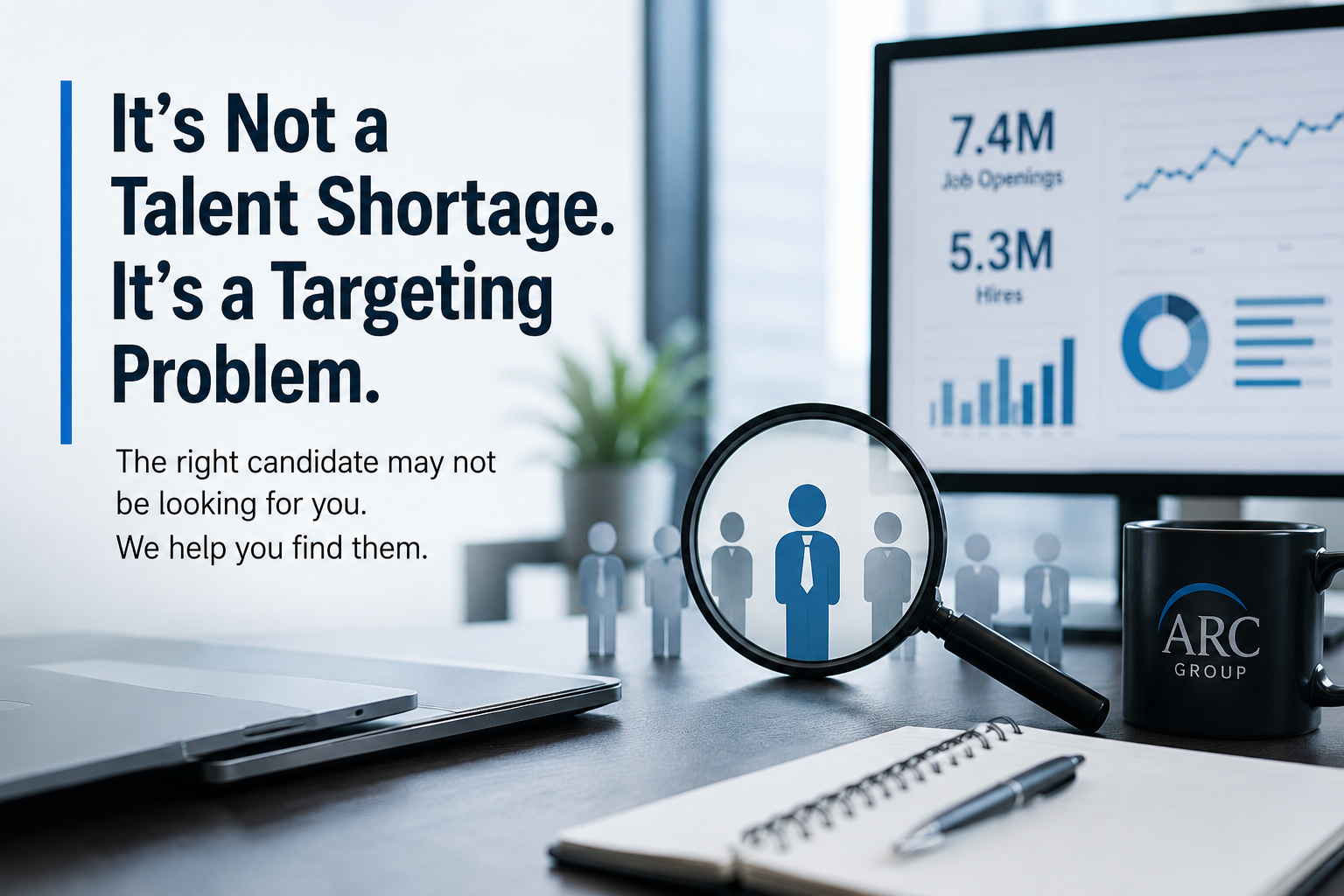
The latest Job Openings and Labor Turnover Survey from the U.S. Bureau of Labor Statistics reported approximately 7.4 million job openings in June 2026, while hires remained at roughly 5.3 million. That gap points to one of the biggest challenges facing hiring teams today: available talent and hireable talent are not the same thing.
For employers, the question is no longer simply, “How many candidates can we find?” It is increasingly, “How quickly can we identify the candidates who can actually succeed in this role?”
More Applicants Don’t Always Mean More Qualified Candidates
A larger applicant pool can create the impression that hiring should be getting easier. But volume can hide a more complicated reality.
Many organizations are receiving applications from candidates who meet some of the requirements but lack the experience, adaptability, industry knowledge, or performance history needed for the position. At the same time, highly qualified candidates may already be employed and have little reason to actively search job boards.
That creates an unusual hiring environment: employers can have hundreds of applicants and still struggle to produce a strong shortlist.
The result is a recruiting problem centered less on candidate volume and more on candidate identification.
The Cost of Searching the Wrong Talent Pool
When hiring teams rely primarily on inbound applications, they are limited to the portion of the workforce actively looking for a new position.
That can be particularly restrictive when recruiting for specialized technical positions, senior leadership, finance, sales, engineering, and other roles where proven performance matters.
Some of the strongest candidates may never submit an application.
They may be performing well for a competitor, leading an important project, managing a team, or simply waiting for the right opportunity before considering a move. Reaching those professionals requires a different recruiting strategy—one built around research, direct outreach, market knowledge, and careful qualification.
This distinction becomes increasingly important as organizations compete for smaller groups of highly relevant candidates.
Speed Still Matters—But Precision Matters More
A long hiring process carries obvious risks. Strong candidates can receive competing offers, lose interest, or decide to remain with their current employer.
But simply accelerating every stage of the process can create another problem: making a faster bad hire.
The better approach is to remove delays that do not improve the hiring decision while spending more time on the parts that do.
Employers should know what the position actually requires before beginning the search. Interviewers should agree on the qualities that separate an acceptable candidate from an exceptional one. Compensation expectations should be evaluated against the current market early rather than after weeks of interviews.
Most importantly, recruiting should begin with a clearly defined target instead of an assumption that the right person will eventually appear in the applicant pool.
Hiring Teams Need Better Market Intelligence
The current environment also makes talent-market information more valuable.
If an organization cannot attract qualified candidates, the problem may not be candidate availability alone. Compensation could be below market expectations. The required experience could be unnecessarily narrow. The interview process could be too long. Competitors may be offering greater flexibility, stronger advancement opportunities, or more compelling roles.
Without visibility into the market, employers can spend weeks searching for candidates who are unlikely to accept the position under its existing conditions.
Effective recruiting therefore requires more than sourcing resumes. It requires understanding where the desired talent is working, what motivates those professionals to move, what competing employers are offering, and whether the organization’s expectations match the realities of the market.
That intelligence allows hiring leaders to adjust before an open position becomes a long-term business problem.
The Best Candidate May Not Be Looking for You
This may be the most important hiring lesson of 2026.
The candidate an organization needs is not necessarily the candidate searching for it.
Job boards and inbound applications remain useful pieces of a recruiting strategy, but difficult searches increasingly require employers to look beyond the active applicant market.
A targeted recruiting process can identify professionals based on the needs of the position first, then determine how to reach and engage those individuals. That reverses the traditional model of waiting for applicants and trying to find the best person among whoever happens to apply.
For critical positions, that difference can significantly improve the quality of the talent pool.
From Filling Positions to Finding the Right People
Millions of job openings do not automatically translate into an easy hiring market.
The organizations that perform best will be those that distinguish between more candidates and better candidates. They will define roles carefully, understand the available talent market, proactively identify qualified professionals, and move efficiently when they find the right fit.
ARC Group has spent more than 40 years helping organizations identify, recruit, and place high-caliber talent. Through our proven recruiting process and Recruitment Intelligence™ approach, we help companies move beyond the applicant pool to uncover candidates who align with the position, organization, and long-term business objectives.
Looking for the right talent—not simply more applicants? Contact ARC Group to learn how our recruiting and Recruitment Intelligence™ solutions can strengthen your next search.